
Summary:
If you’ve been told to lose weight before starting IVF, or you’re managing PCOS while trying to conceive, you already know how frustrating it is when your care feels scattered. Your OB says one thing. Your nutritionist says another. Nobody’s talking to each other, and you’re the one trying to hold it all together.
What most people don’t realize is that the weight and the fertility challenges are often coming from the same place — a hormonal and metabolic imbalance that Western medicine tends to treat one piece at a time. Traditional Chinese Medicine approaches it differently. Here’s what that actually looks like in practice.
Does Acupuncture Work for Weight Loss?
The short answer is yes — but not in the way most people expect. Acupuncture doesn’t burn calories or suppress appetite the way a medication might. What it does is work on the systems that regulate your hunger, metabolism, and stress response at a hormonal level.
Research published in 2024 confirmed that acupuncture modulates the hypothalamus, regulates key hormones including leptin, ghrelin, insulin, and cortisol, and influences what researchers call the brain-gut axis. These aren’t fringe claims — they’re documented biological mechanisms. A 2024 network meta-analysis covering 46 studies and nearly 4,400 patients found that TCM treatments were more effective for weight loss and BMI reduction than non-pharmacological interventions and placebo, particularly when treatment lasted six months or less.
How TCM Identifies the Root Cause of Weight Gain
In Traditional Chinese Medicine, weight gain isn’t a standalone problem — it’s a signal. Depending on your constitution and health history, it might reflect a spleen Qi deficiency that slows your body’s ability to process and transform what you eat. It might show up as what TCM calls phlegm-dampness accumulation, which maps closely to what Western medicine recognizes as sluggish metabolism and fluid retention. Or it could be liver Qi stagnation — the pattern most commonly associated with stress-related eating and cortisol-driven fat storage around the midsection.
This is where TCM diverges most sharply from conventional weight loss approaches. Rather than applying the same protocol to everyone, a licensed TCM practitioner starts by identifying which pattern is driving your specific situation. Pulse assessment, tongue diagnosis, and a detailed health history intake all factor into that picture. The treatment plan that follows is built around what your body is actually doing — not a generic framework.
For Nassau County residents who spend long hours commuting and managing the particular kind of pressure that comes with living in the New York metro area, cortisol dysregulation is genuinely common. Chronic stress elevates cortisol, which promotes fat storage, disrupts insulin sensitivity, and — critically — interferes with the hormonal signals your body needs to ovulate regularly. Addressing that upstream is what makes TCM weight management different from another diet plan.
When herbal medicine and diet counseling are integrated alongside acupuncture, the results become more meaningful. A 2023 retrospective study tracking over 11,000 patients across seven clinics found a peak average weight loss of approximately 17.5 kg after seven months of weekly acupuncture combined with dietary intervention. That’s not a dramatic outlier — it’s a consistent outcome across a large patient population when the treatment is applied systematically and the patient is engaged in the process.
What Acupuncture Points Are Used for Weight Loss?

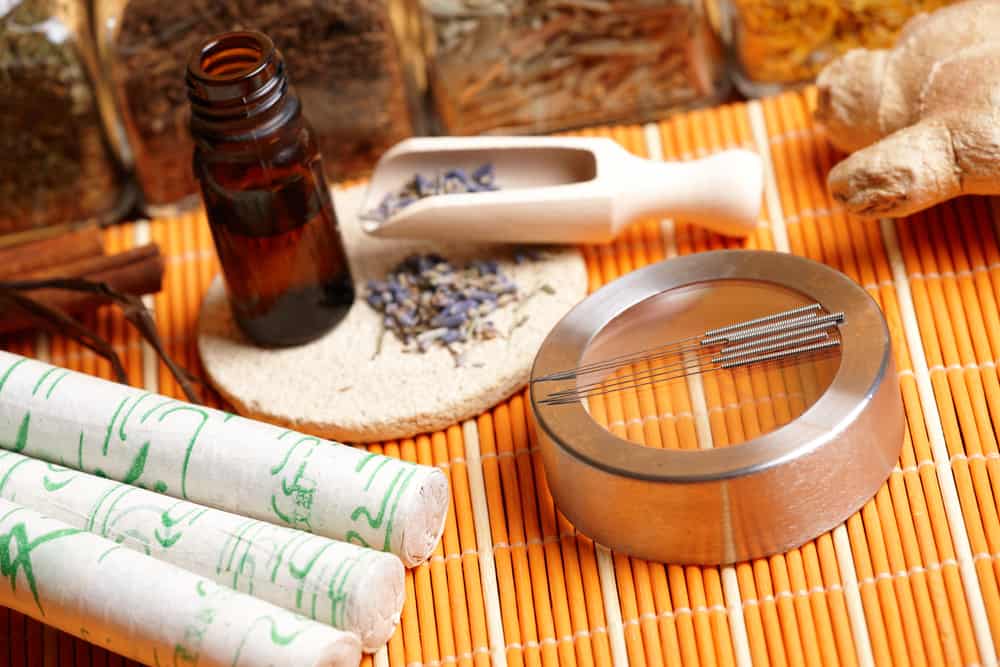
There are two main approaches used in TCM weight loss treatment: body acupuncture and auricular acupuncture, which targets specific points on the ear. The ear points most commonly used correspond to the stomach, hunger, and endocrine system — areas that influence appetite signaling and hormonal regulation. Body acupuncture for weight management typically focuses on points along the spleen, stomach, liver, and kidney meridians, which in TCM govern digestion, fluid metabolism, and hormonal balance.
Electroacupuncture — where a mild electrical current is applied through the needles — is sometimes used to enhance the stimulation of these points, particularly for patients dealing with significant metabolic sluggishness or insulin resistance. Most patients describe the sensation as a mild, rhythmic pulse. The goal is to amplify the body’s own regulatory response rather than override it with an external substance.
For patients with PCOS specifically, the combination of auricular and body acupuncture has shown measurable effects on the hypothalamic-pituitary-ovarian axis — the hormonal feedback loop that governs ovulation. Research published in Frontiers in Endocrinology confirmed that acupuncture can promote ovulation and improve insulin resistance in PCOS patients simultaneously. This matters enormously for Nassau County women who are dealing with PCOS-related weight gain and trying to conceive, because these aren’t two separate problems requiring two separate solutions. They share the same hormonal root.
What we do at Think Acupuncture is build a treatment plan that accounts for all of this — not just the number on the scale. If you’re carrying extra weight because your body is under chronic stress and your hormones are dysregulated, the path forward looks very different from someone whose weight gain is primarily dietary. That distinction is what a thorough TCM intake is designed to surface, and it’s what makes the treatment actually work.
Reproductive Acupuncture: Where Weight and Fertility Intersect
Your body weight directly affects your fertility outcomes. Not as a matter of appearance or lifestyle judgment — as a matter of biology. Adipose tissue produces estrogen. When there’s excess of it, the hormonal environment shifts in ways that disrupt ovulation, impair egg quality, and reduce the receptivity of the uterine lining. For women undergoing IVF, it can also affect how the body responds to stimulation medications.
Reproductive acupuncture addresses this by working on the same hormonal pathways that connect metabolic health to reproductive function. It’s not a replacement for your reproductive endocrinologist’s protocol — it’s the piece that works on the underlying terrain while your RE manages the clinical intervention.
Chinese Medicine for Fertility: What the Research Shows
The research on Chinese medicine for fertility is more robust than most people realize. A Tel Aviv University study found that women who combined acupuncture and Chinese herbal medicine with their IUI cycles had a pregnancy rate of 65.5%, compared to 39.4% for women who did IUI alone. The take-home baby rate was 41.4% versus 26.9%. Those aren’t marginal differences — they’re clinically significant, and they hold up across multiple studies.
A separate systematic review found that Chinese herbal medicine improved pregnancy rates approximately two-fold within a four-month period compared to fertility drug therapy alone. For patients who have already been through one or more IVF cycles without success, or who are preparing for their first cycle and want to optimize their chances, these numbers matter.
The mechanism isn’t mysterious. Acupuncture increases blood flow to the uterus and ovaries, supports the development of a thicker uterine lining, and reduces the cortisol and anxiety load that can interfere with implantation. Chinese herbal medicine works on hormonal regulation and cycle regularity over a longer arc. Diet counseling addresses the nutritional foundation that supports both egg quality and metabolic health. When these are combined into a single, coordinated treatment plan — which is what we do — the effect is cumulative.
For Nassau County patients who are already navigating the financial and emotional weight of fertility treatment, the framing matters. IVF is a significant investment. TCM doesn’t replace that investment — it works to make it more likely to succeed. And for patients whose reproductive endocrinologist has flagged weight or metabolic health as a factor in their fertility, TCM weight management isn’t a side project. It’s part of the same clinical goal.

How TCM and Western Fertility Medicine Work Together in Nassau County, NY
One of the most common concerns we hear from new patients is some version of: “Will my doctor be okay with this?” It’s a fair question, and the honest answer is that most reproductive endocrinologists are familiar with acupuncture as an adjunct to fertility treatment and have no objection to patients pursuing it alongside their ART protocol.
What makes the integration work in practice is communication. At Think Acupuncture, our practitioners work alongside your existing healthcare team — not in opposition to it. If your OB or RE has given you specific guidance, we factor that into your treatment plan. If there are contraindications or timing considerations around your IVF cycle, we account for those. The goal is a coordinated approach where Eastern and Western care are informing each other, not operating in separate silos.
This matters particularly for Nassau County residents, where the healthcare infrastructure is dense and sophisticated. Northwell Health, NYU Langone, and other major systems in the region have practitioners who are familiar with integrative medicine conversations. You don’t have to choose between the two approaches — and you shouldn’t have to explain yourself for wanting both.
The timing question also comes up frequently. For patients planning a spring IVF cycle, starting TCM support in the fall gives the body three to six months to respond — which is roughly the window research suggests is needed for meaningful hormonal and metabolic shifts. For Nassau County residents who are thinking ahead and want to approach their next cycle differently, fall is the right time to start. Not because of an arbitrary calendar, but because the body needs time to regulate, and the earlier you begin, the more ground you can cover before transfer day.
Our practitioners hold New York State licensure and are nationally board certified in both acupuncture and Chinese Herbology — a dual credential that goes beyond the minimum state requirement. We accept most major insurance plans including NYSHIP, United Healthcare, Aetna, and Empire BCBS, which removes a barrier that keeps a lot of people from exploring this path sooner than they should.
Is TCM the Missing Piece in Your Fertility and Weight Loss Plan?
If you’ve been managing weight and fertility as two separate problems, it’s worth reconsidering that framing. The hormonal and metabolic factors that drive weight resistance — cortisol dysregulation, insulin resistance, PCOS, sluggish metabolism — are the same factors that complicate conception. Treating them together, through a coordinated TCM approach that works alongside your existing Western care, is not a compromise. It’s a more complete strategy.
The research supports it. The mechanisms are documented. And for Nassau County residents who are already in the fertility system and looking for a way to improve your odds without adding more medications to the mix, acupuncture and Chinese medicine offer a low-risk, evidence-backed option that most people wish they’d started sooner.
If you’re ready to understand what’s actually driving your weight and how it connects to your reproductive health, Think Acupuncture is the place to start that conversation.